
Blogs I Love: Ceros

I love to make things. Starting with a great story, turning it into a captivating poster or a compelling video and standing back to appreciate what you’ve created as you share it with the world – it’s hard to find another feeling so satisfying.

So, as personal circumstances have pulled me away from daily professional creative challenges, I’ve spent a lot more time reading blogs from other creatives to absorb as much insight as I can to learn how they find solutions for their clients. One of those great blogs comes from Ceros.
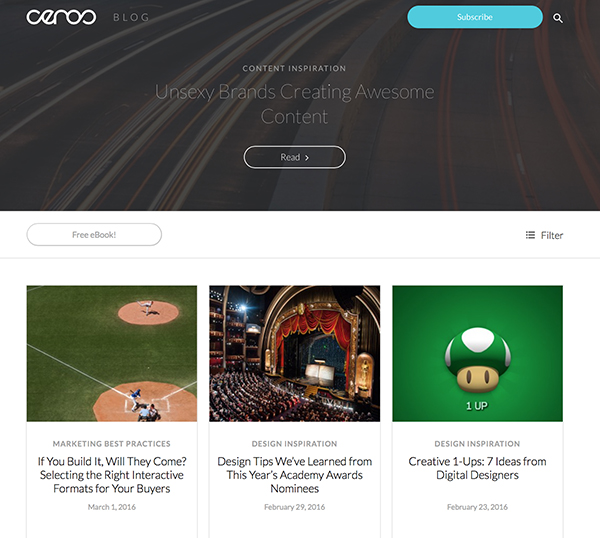
CerosBlog

Ceros, makes interactive content creation software that requires no coding. A great creative tool, indeed. But it’s the Ceros blog that attracts my attention. The blog is essentially an advice column, a guide to best practices and great ideas for creatives and digital marketers.

But, they have a product to sell, right? Of course, they have a product to sell. But unlike a lot of commercially-operated blogs out there, the ones that ONLY create blog posts that promote their product or constantly push visitors to a conversion, the Ceros Blog defies convention. Each post is an authentic and critical look at the digital marketing world around. A showcase of great ideas and the inspiration behind them. And, instead of shilling their product, they use their product to help  visually tell the story of their posts.

In this post about learnings from a content for conversion marketing conference, Ceros presents the info through an animated infographic created using their product. But the focus of the post is instead about sharing the insights – not prompting their product.
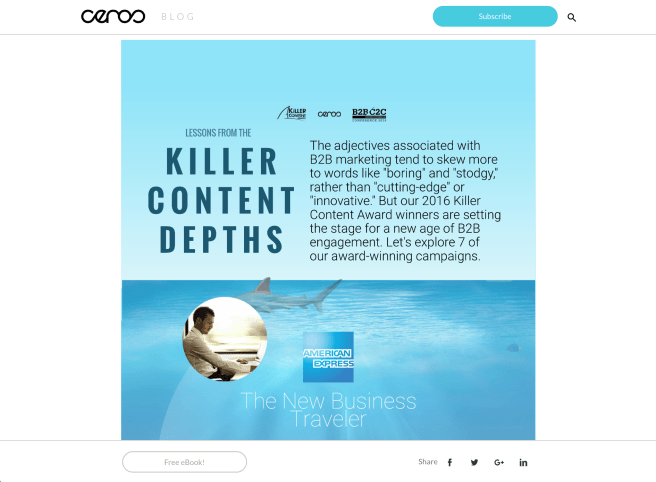
Screen Shot 2016-03-01 at 4.59.34 PM

The Ceros blog design is clean and simple to navigate. Each post is rich with real  examples of creative content and their strategic applications in real-world campaigns. For anyone interested in witnessing great digital applications of creative marketing content, the Ceros blog is one to follow.

Check it out. Let me know what you think. And share some of your favorite blogs in the comment section below.
Politicians are Talking Tech in the Fight Against Terrorism

Now officially labeled a terror attack, the shootings in San Bernardino are heightening concerns about the many ways digital technology and the internet is emboldening those with extreme ideologies – especially when it comes to communication and recruitment.

The President himself raised these concerns in his speech to the nation on Sunday and challenged the tech industry to take action – although the specifics of that action are still unclear. “I will urge high-tech and law enforcement leaders to make it harder for terrorists to use technology to escape from justice,” The President said.

Former Secretary of State and current Presidential Candidate Hilary Clinton came out even stronger during her recent appearance on ABC’s “This Week” and at several other appearances since the attack. She specifically called on companies like Facebook, Google and Twitter to take action against against terrorists on the internet and “deny them online space.”

Clinton led the chorus calling on industry and government to come together to address concerns over encrypted apps and software. Many claiming that the tools designed to protect people online are providing too much cover to terrorists and others attempting to use the web for criminal purposes.

It’s more complicated with some of what [ISIS does] on encrypted apps and I’m well aware of that. That requires even more thinking. -Hillary Clinton, Presidential Candidate

Of course, this type of debate raises concerns about the open nature of the internet and possible threats to freedom of speech online. The industry understands these concerns and is offering its own proposals – most short of offering investigators a backdoor into encrypted communication of its users. Facebook is pledging to scrub feeds for posts promoting violence and cancel any account behind such activity. Meanwhile, Google Chairman Eric Schmidt urged action as well, without mentioning the hot topic of encryption.

We should build tools to help de-escalate tensions on social media — sort of like spell-checkers, but for hate and harassment. We should target social accounts for terrorist groups like the Islamic State, and remove videos before they spread, or help those countering terrorist messages to find their voice. – Eric Schmidt, Google Chairman

So for now, the tech industry is holding the line. Supporting the efforts to weed out terror and violence – while trying to protect the freedoms of an open internet. But, will they be able to continue this position after the next violent attack?

What do you think? Share your comments.

Giving Your All on #GivingTuesday

Now that Black Friday and Cyber Monday have sucked your wallets (and possibly your souls) dry…it’s time to feel good about all of those online transactions. Giving Tuesday is about to invade your inbox and fill your newsfeed digital pleas of every shape and size – all asking for the little that’s probably left in your pocketbook.

NPR has reported that more than 350,000 charities participated in Giving Tuesday in 2014 – raising more than $46 million. That’s big business, especially for smaller non-profits – and the companies that make online giving tick. Blackbaud, most dominant provider of online philanthropic services will partner with Microsoft to create a #GivingTuesday “Dashboard” to show “giving trends” throughout the day. While more detailed online giving data will be gathered on this busiest of donation days – and will be crunched and analyzed in order to drive online strategies for Giving Tuesday and beyond.

For the donor, you and me, like any other day of the year, it’s important to know who to whom you’re giving – and how that gift will make an impact. Mashable provides a great list of tips to help guide your online giving to organizations that truly make a difference and make the most with each dollar donated. There are plenty of online resources, like Charity Navigator, to help you find a charity that best fits your personal values and interests.

Don’t think that Giving Tuesday will come and go and that will be the last you hear from charities both big and small this year. The onslaught “donate now” emails and Facebook posts will continue throughout the month of December as organizations race to meet their end-of-year budgets and urge potential donors to earn credit on their 2015 tax returns by giving before midnight on the 31st. That push works, as The Network for Good’s Digital Giving Index repots that 12% of online giving in 2014 happened on the last three days of the year.

So now you know why you’re getting all of that email. Because it works.

Happy charity hunting!


To the User of Data Goes the Spoils

We’ve been reading and talking a lot about data in our most recent digital communications studies. They’re calling it Big Data now, mainly because there is so much of it to analyze and so many different ways to do it. But no matter who’s crunching the numbers, the end goal is always the same. WIN! WIN! WIN!

Take The University of Georgia football program. They have begun tracking  and analyzing all aspects of their athletes physical performance. We’re not talking yards rushed and passes completed here. What coaches and trainers are looking at is the player’s the physiological information – heart rate, blood pressure, oxygen saturation, how much a player moving and running – all tracked with a combination of GPS and medical monitoring technology. The goal: To know how a player is doing physically and when they should be seeking the services of trainers and medical professionals to address issues they may not even know exist.

Crunching the numbers has always been a big part of baseball. But in today’s digital world, teams across the country, the Detroit Tigers for one, are digging even deeper by adding data analytics who are tracking all aspects of the team operation – both on and off the field.

This week IBM launched the Watson Trend APP, intended to help holiday shoppers stay ahead of the pack. By pulling information from thousands of sources like blogs social media, e-commerce and review sites to provide a real-time list of the 100 top products in multiple categories.

Big Data is also making it’s mark in campaign politics. While the 2008 Obama Presidential run is often credited as the first campaign to effectively mobilize and capitalize on a concerted digital effort, the 2016 presidential campaign is the first to be heavily influenced by the analysis of big data. The campaigns with limited analytics resources will be too far  behind to compete in this digital age.

So whether it’s sports, business or politics the game is definitely changing. The winners aren’t the ones gathering the most data. That’s just half the battle. Rather, those enjoying the spoils will be those who embrace the role of analytics and invest in the human resources and powerful technology it will take to turn information into winning results.


Digital Convergence in Times of Terror

As media in all forms erupts in the wake of last week’s attacks in Paris, it is difficult not to view the tragic events through the critical lens we are developing during our study of this modern era of rapid digital convergence.

The impact of technology on these events goes much deeper than instant news notifications and customized profile pictures. And, as we marvel at the deployment of technology to rally the good of man, we must also recognize the role these platforms and networks play in the organization and implementation of extreme agendas.

As hours moved the events from an active terrorist attack to a rescue and recovery operation, the headlines also shifted and the response of the online community became part of the story. Airbnb launched a portal offering anyone displaced by the attacks free places to stay. This, while the company was forced to cancel their Airbnb Open Conference, a gathering of more than 5,000 delegates to be held in Paris the weekend immediately following the attacks.

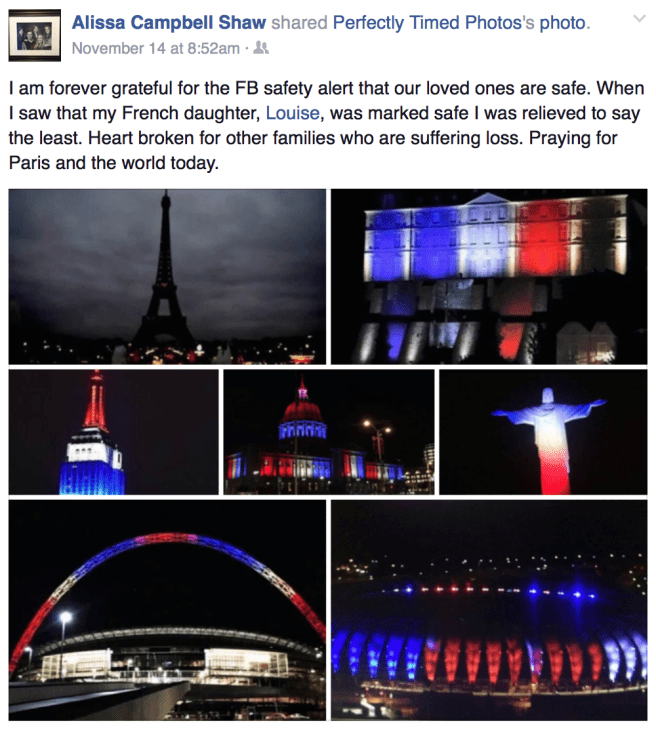
Facebook was on the receiving-end of some early positive press after enabling a check-in feature allowing users in and around Paris to share their safety status. One of my own Facebook friends was a beneficiary of this function and posted about it Friday night.

Screen Shot 2015-11-16 at 4.31.40 PM
Source: Facebook user Alyssa Campbell Shaw

But, the tone across social media quickly shifted as the Facebook was criticized for not activating the feature during a previous attacks on Beirut.

On the other end of the spectrum…ISIS claimed responsibility for the brutality using messaging platform Telegram – the same platform where the organization took credit for the downing of a Russian airliner over Egypt several weeks ago. These claims followed by multiple threats of future attacks, specifically against the U.S. in Washington, D.C., via several known ISIS recruiting sites.

Gaming platforms are receiving closer scrutiny from authorities with new reports that extremists may be using the communication functions of Sony’s Playstation 4 to recruit members and plan attacks after the devices were uncovered during raids in Belgium.

And today, as Paris continues three days of mourning, headlines shift again with the news that one of the eight suspected attackers accessed Europe by embedding himself with Syrian refugees. Governors from multiple states announced bans on incoming refugees setting social media ablaze with debate on both sides of the issue.

Stunning to see how quickly the story of the Paris attacks has evolved since Friday and heavy influence of technology and digital media across so many different aspects – social, political, commercial – and from different sides. How do you think digital technology is influencing the state of affairs? Will it help bring us together or play a role in tearing us apart in these trying times?

Share your thoughts in the comments below.


Back in the SYR – Comm@Syracuse Immersion

To say I got the feeling of déjà vu this week would be an understatement.

20-years-ago, when we were still editing tape-to-tape and browsing this strange new internet via Netscape, I was a bright-eyed and bushy-tailed undergrad at the S.I. Newhouse School of Public Communications at Syracuse University. I would have never guessed that, so many years later, I would be back in the same exact place, doing many of the exact same things – like staying up all night to cram in that last assignment, or stopping by The Acropolis for that late-night slice of pizza.

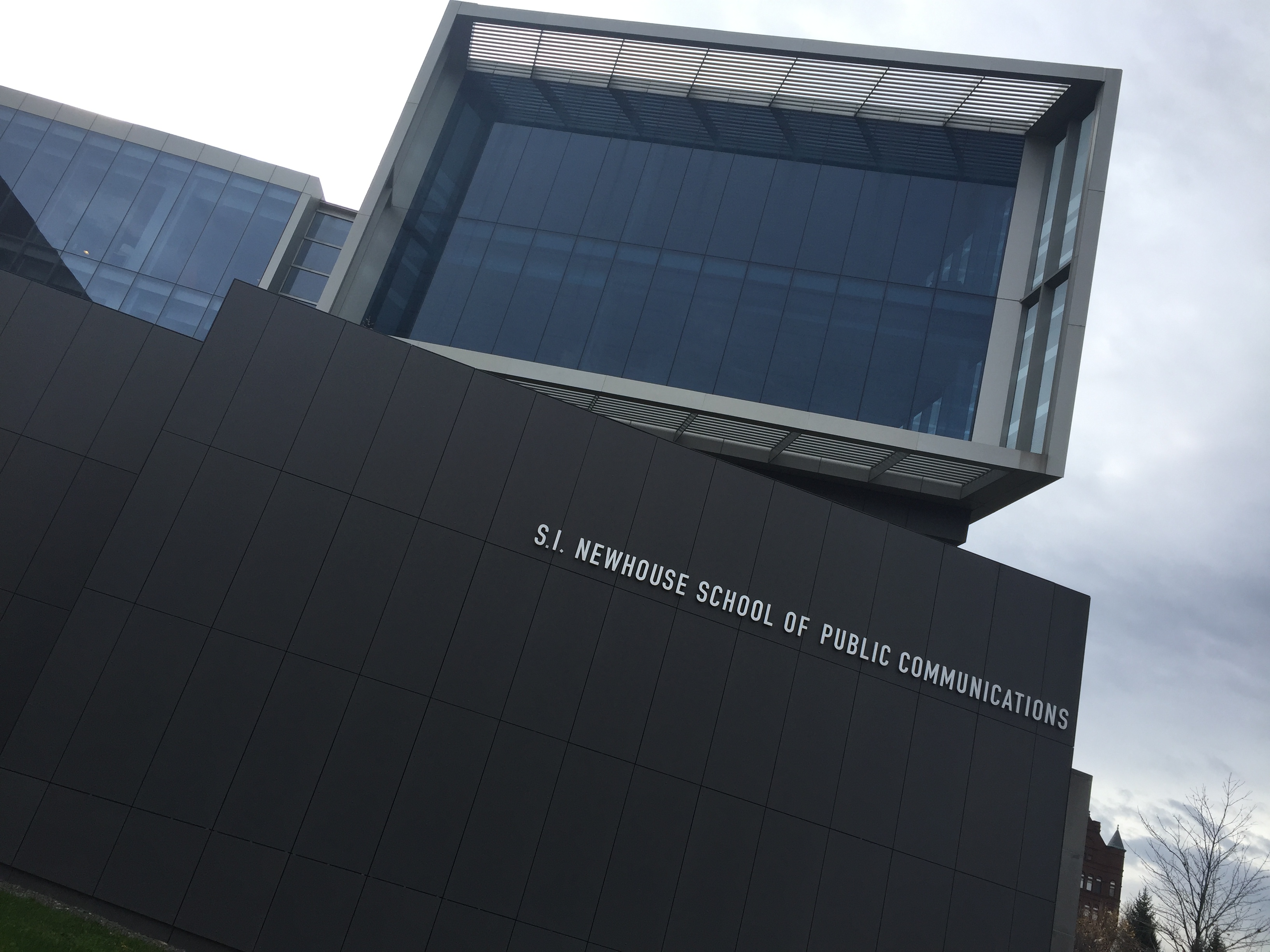
There were only two Newhouse buildings back then. And oh, how things have changed. Glistening in the sunlight, a monolith of  glass and stainless steel, wrapped in the words of the First Amendment, Newhouse 3 appears to be bursting from, but connected to the walls of Newhouse 2. Quite symbolic in itself, when you consider this age of digital communications and media convergence is exploding with the new, but still must be firmly-anchored by the practices and polices of traditional journalism and communication.  To move forward, we must sometimes look behind.

The Newhouse 3 Building on the campus of Syracuse University.

That said, I’ve done a lot of looking back this weekend as the students of the Comm@Syracuse online master’s program visit campus for our first immersion. Revisiting the reasons why I decided to pursue communications as a profession in the first place. Recalling the many wise and encouraging professors who helped guide and train me, providing me with the access to state-of-the-art tools (granted, at the time) that fueled a rewarding career thus far – first as a journalist, then as a brand storyteller.

But this weekend is also about looking ahead. Trying to map a personal and professional future in this ever-changing digital media landscape. And again, The Newhouse School sits at the cutting-edge – providing students with the best tools and training. And, even more importantly, giving us access to a wide-array of amazing professionals from the fields of journalism, advertising and public relations. All are ready and willing to impart their amazing experience and open doors of new opportunity as we try to decide where exactly this Master’s Degree in Communications is going to take us.

But even more inspiring than the teachers are the students. Our fellow classmates come from across the country and around the globe. Each bringing their unique experience and perspective to the table as we contemplate the opportunities and ramifications of the digital world in which we live. It is truly a privilege to be working with this amazing group of colleagues and I’m looking forward to more collaboration as we pursue our degrees.

Now…let’s go to Faegan’s.